A First-Time Volunteer’s One-Task Plan
A first-time volunteer one-task plan helps you agree on a clear job, set its limits and hand it over cleanly at a one-day community project.
A first-time volunteer one-task plan makes a one-day community project easier to join: agree on one clear job, know where it begins and ends, then hand it over cleanly. You do not need to arrive with a grand idea or promise the whole day. A useful contribution might be sorting donated books, preparing name cards or carrying finished posters to a display table. The point is to leave the organiser able to say what is done and what, if anything, remains.
What can you offer before you arrive?
Start with the time and attention you can genuinely give. Think about when you can arrive, when you must leave, and whether you can stay on your feet or need a seated task. Mention any practical limits plainly. That is more helpful than saying yes to an open-ended job and having to disappear halfway through it.
Then ask what the project needs that fits those limits. A short message can be enough: “I can come in the morning and would be glad to take one defined task. What needs doing?” If the organiser has a signup form, use its role descriptions to choose something that sounds manageable. Avoid selecting a task based only on its title; “help with setup” could mean anything from arranging chairs to coordinating deliveries.
You can also say what you already know how to do, without turning it into a pitch. Perhaps you are comfortable labelling boxes, using a spreadsheet, speaking with visitors or making simple signs. If a role needs a skill you do not have, say so before the day. A first task should be useful, but it should also be something you can carry out with the guidance available.
Before you commit, confirm the arrival point, the name of the person to ask for and what to bring, if anything. Do not assume that a community hall has spare gloves, pens or a place to store a bag. A concise exchange now can prevent you from arriving unsure where to stand or whom to approach.
How do you agree on one clear task?
At the project, ask the organiser to describe a single piece of work in plain terms. A good task has a visible result and a natural stopping point. “Put the labelled recipe cards into the matching folders” is clearer than “sort out the display”. The more specific version tells you what to handle, what counts as finished and what you should leave alone.
Use a few direct questions to pin down the assignment:
- What is the finished result? Ask what someone should be able to see when the task is complete.
- Where does the task start and stop? Clarify which table, room, pile or set of materials belongs to it.
- What should I use? Confirm the supplies and any instructions that matter, rather than borrowing tools or changing materials without asking.
- Who decides if I am unsure? Get the name of the person who can answer questions or approve a change.
- What should I do when I finish? Agree on where to report back and whether there is a next task to discuss.
Repeat the agreement in your own words. For example: “I’ll put these prepared cards into the blue folders at this table, leave the unlabelled stack untouched and let you know when this batch is done.” The organiser can correct a misunderstanding before it turns into rework.
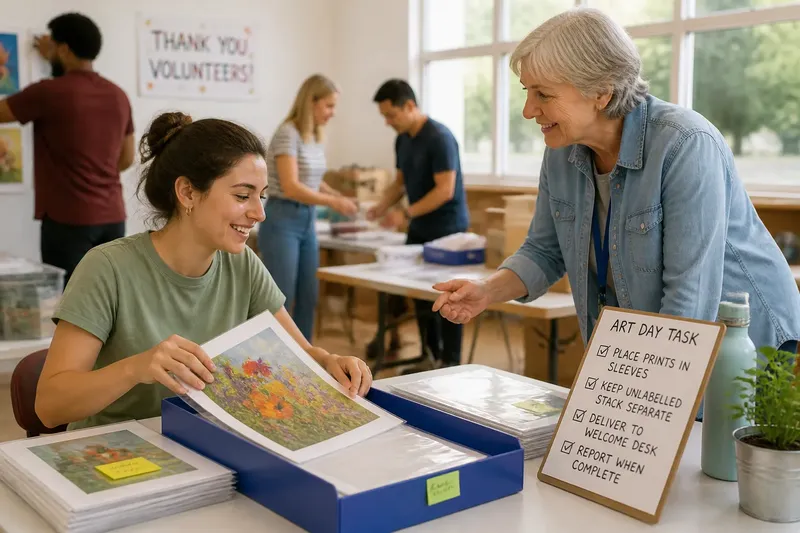
Imagine you arrive at a neighbourhood art day and the organiser asks you to “help with the wall”. You explain that you can stay until lunch and ask what one part would be useful. The organiser gives you the finished prints to place in marked sleeves, points out a separate stack that belongs to someone else and asks you to bring the completed sleeves to the welcome desk. When you finish, the labelled pile is ready for the next person, and the organiser knows exactly what remains.
Where should you draw the boundaries?
A clear task needs boundaries around both the work and your responsibility. Confirm which materials are yours to handle, which decisions belong to the organiser and what you should do if the agreed plan no longer fits. You are volunteering to complete a piece of work, not to quietly take charge of a whole area because nobody else is standing nearby.
Boundaries matter when a task touches other people’s contributions. If you are arranging posters, for instance, ask whether you may move pieces already placed. If you are packing donated items, check how to handle anything damaged, personal or unlabelled. Do not make choices about another person’s work merely to keep the task moving. Set those items aside in a clearly agreed place and ask the named contact.
It is also fine to pause when the assignment changes. The organiser may discover that a delivery is late or that a room needs a different setup. Ask whether the new request replaces your original task, adds to it or can wait until the first job is handed over. If the change exceeds your time or comfort, say what you can still complete and when you need to leave.
For work involving equipment, materials or responsibilities with safety implications, follow the organiser’s directions and the relevant label, manufacturer instructions or local rules; ask for a suitable alternative if the task is not within your ability. Do not improvise around a risk just because the project is busy.
What should you do while working?
Keep the agreed result in view. If the task is sorting, use the categories the organiser supplied rather than inventing new ones. If you are preparing a display, follow the marked layout before suggesting changes. This keeps your work legible to the next volunteer and avoids making decisions that were never part of your assignment.
Ask early when something does not match the instructions. A stack may contain an item with no label, or a box may be fuller than expected. Rather than guessing, pause that part and ask the contact person what to do. You can continue with the items that are clear, provided doing so does not mix them with the uncertain material.
Keep the work area easy to read. Put completed items where agreed, keep unfinished items distinct and leave shared tools where others can find them. If you take a break, tell the nearby organiser or teammate where the task stands. A short update prevents someone else from mistaking a paused job for a finished one.
Notice when the task has reached its agreed boundary. Do not quietly expand it by taking on adjacent work unless the organiser agrees. If you finish early, report back and ask whether there is another suitable task; the organiser may prefer you to stop, or may have a small next job that fits your available time.
How do you hand the task over?
Before leaving, make the result and its status easy to understand. Tell the organiser what you completed, where you placed it and whether anything is unfinished. If there is a remaining item, point to it rather than describing it vaguely. A useful handoff might sound like: “The labelled folders are ready on the welcome desk. I left three cards without matching labels in the tray beside them; I didn’t file those.”
Return borrowed supplies to the agreed place and make sure unfinished work is not mixed with completed work. If someone else is taking over, introduce them to the organiser or explain the task’s current state only if that is part of your role. The organiser remains the person who confirms priorities and assigns responsibility.
Give yourself a moment to check that the handoff happened before you leave. If the organiser is occupied, ask whom to update or send a brief message through the contact method already agreed. You do not need to stay indefinitely waiting for praise or a new assignment; you do need to make the status clear.
What might a first-time volunteer ask?
What if I do not know what task to choose?
Tell the organiser how much time you have and ask for one task with a visible finish. You can also name a practical preference, such as seated work or a role away from the doorway, so they can suggest a better fit.
What if the task is bigger than I expected?
Pause and describe what has changed: the materials, the time needed or the decision now being asked of you. Ask whether to narrow the task, leave part for another volunteer or stop at the boundary you first agreed.
Can I change tasks halfway through?
Yes, but tell the organiser before switching so the original task does not become an unexplained loose end. Agree on what should happen to the unfinished portion and who will take responsibility for it.
How do I leave without seeming unhelpful?
State your agreed leaving time, report what is complete and identify anything still pending. A clear handoff respects the project more than staying beyond your capacity without telling anyone where your work stands.
How can one task make a useful contribution?
A one-day project does not need every volunteer to solve every problem. It needs people to make clear commitments that others can pick up, understand and continue. When you agree on one task, protect its boundaries and hand it over plainly, you give the group something more useful than vague availability: a finished piece of shared work, with its status visible to the next person.
Keep the first-time volunteer one-task plan close at hand: ask what is needed, define the finish, respect the limits and report back. That small discipline helps you leave on time while letting the project carry on without guessing what you did.