The Quiet Work of a Good Welcome
A good welcome gives newcomers clear cues about where to go, what to expect and how to join a gathering without having to ask for every detail.
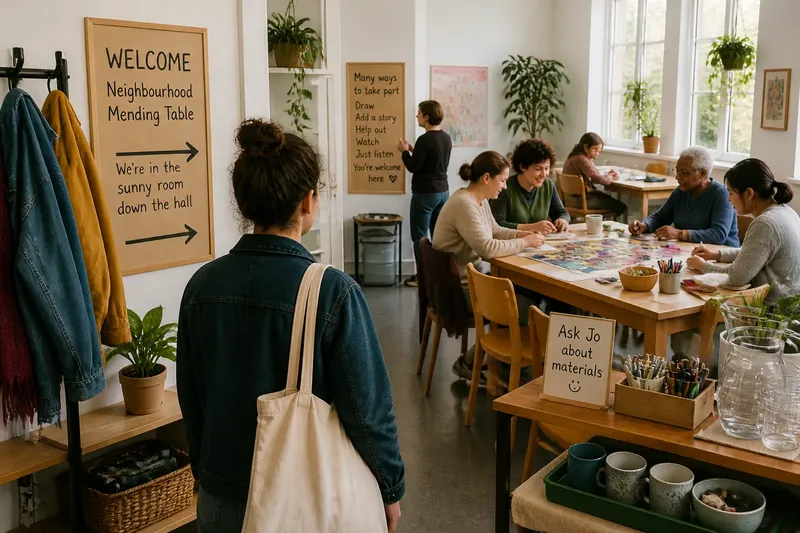
A good welcome begins before anyone says hello. At a community craft table, a sign by the entrance, a clear path to the activity and a visible place to put a coat can tell a newcomer where to go without making them announce that they are new. These small, predictable cues make a gathering easier to enter because they turn an unfamiliar room into a sequence of understandable choices.
The quiet work is not about making every visitor feel instantly at ease. It is about removing avoidable guesswork while leaving people free to take part in their own way. A welcome can be warm and still let someone watch first, arrive late or ask for a different role.
What does a newcomer need to know first?
Someone arriving for the first time is often solving several small puzzles at once: Is this the right room? Should I speak to someone? Is the activity already under way? Can I sit down without interrupting? A host may know the answers by heart, but the newcomer cannot see that knowledge.
Start with the first decision a person faces on arrival: where to go. Put the gathering’s name or purpose near the entrance, then make the route to the main space obvious. If there are several doors, a simple arrow can help. If the room is down a corridor, a greeter near the turn may be more useful than a welcome table hidden inside.
Once people reach the room, show them what is happening. A table laid out with paper, pencils and an unfinished communal collage signals an activity more clearly than a stack of supplies left in boxes. A few chairs angled towards the table suggest that sitting down is welcome. The objects themselves can explain the invitation.
Make the next action visible. Put coats in one recognisable place, keep materials together and leave a clear route to seats. A newcomer should not have to cross the room carrying an uncertain expression while everyone else continues chatting.
Before the gathering opens, walk in from the entrance and notice what you cannot yet tell.
How can cues make joining feel optional?
Clear information and gentle permission belong together. A person may understand exactly what the group is doing and still need a little time before joining. A welcome that treats immediate participation as the only successful outcome can turn friendliness into pressure.
Offer more than one legitimate way to be present. For a neighbourhood poster-making session, someone might choose a seat at the table, sort coloured paper, watch for a while or simply listen. The host can name those options in plain language rather than making each newcomer negotiate a special exception.
Use invitations that leave room for choice. “There’s space here if you’d like to draw, and you’re welcome to watch first” gives a useful next step without demanding one. By contrast, a rapid round of introductions can make a quiet arrival feel like a performance, particularly if a person has not yet learnt anyone’s name.
Small choices matter too. A chair at the edge of a circle can be easier to take than a seat that requires squeezing between regulars. Materials placed within reach let people begin without asking permission. These are practical signals: you can come closer, but you do not have to.
What should a host say at the door?
A useful greeting is short, specific and easy to answer. “Hello, this is the neighbourhood mending table. We’re working near the windows; coats can go on that rack” offers orientation before the newcomer has to ask for it. The host can then give their name and point out another person who can help.
Avoid turning the first encounter into an interview. Questions about how someone heard of the event or whether they live nearby may be well meant, but they can feel like an entrance test if asked before the person knows what the gathering is. Offer basic information first; let conversation develop at the visitor’s pace.
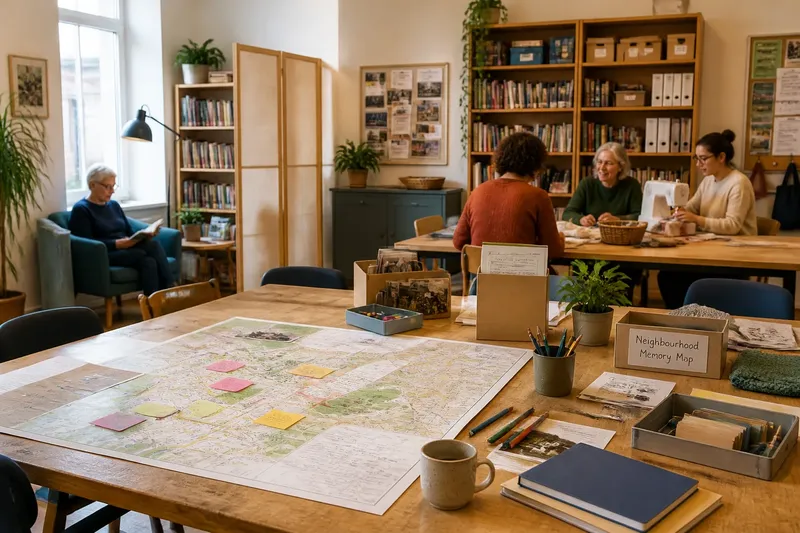
Say you are hosting a shared map-making evening and a visitor arrives while people are already drawing. You could point out the blank maps, explain that people are adding places they value, and show where spare pens sit. The expected observable result is simple: the visitor can choose a pen, watch the table or ask a question with a clear sense of what is going on.
When the room is busy, a named point of contact helps. A small sign saying “Ask Jo about materials” is more useful than expecting a newcomer to work out which regular looks approachable. If the named host steps away, arrange for someone else to take that role.
How do you make the welcome work for different people?
One cue will not suit everyone. Spoken directions can help someone who does not read the language on a sign, while written directions give a person time to take in information without asking aloud. Use both where possible: a clear sign, a spoken greeting and a visible example of the activity.
Keep signs readable and direct. “Tea and water” above a drinks table is easier to act on than a playful phrase only regulars understand. A simple room plan can help in a large venue, but it should match the route people actually take. If a lift, accessible toilet or quiet corner matters to the event, make its location easy to ask about or find.
Sound and pace are cues as well. A loud welcome at the door may suit a lively celebration but overwhelm someone arriving cautiously. Hosts can speak at a conversational volume, avoid calling newcomers across the room and leave a pause after giving directions. A person needs time to decide what to do with the information.
Do not assume that a familiar format is self-explanatory. A circle discussion, shared meal or craft activity may have customs that regulars no longer notice. Briefly explain how turns work, whether people serve themselves and what to do with unfinished work. Those details make the gathering legible without requiring newcomers to imitate the group first.
What should you check after the first arrivals?
Watch the room rather than judging the welcome by how cheerful it sounds. Do people stop at the entrance and scan for clues? Do they hover near supplies? Do they have to interrupt a conversation to find a seat? These moments reveal where the room is asking visitors to do extra interpretive work.
Make small adjustments while the gathering is under way. Move a sign to the doorway people actually use, bring spare chairs within sight or ask a host to stand near a confusing junction. If several people ask the same question, add the answer to the room rather than repeating it one person at a time.
Afterwards, invite feedback without making newcomers responsible for redesigning the event. A simple question such as “Was anything hard to find when you arrived?” can uncover a practical snag. The organiser can then decide whether a sign, clearer layout or different greeting would help next time.
What questions do organisers often ask?
Should every newcomer be introduced to the whole group?
No. Offer an introduction as an option, especially if the gathering already has a routine for it. A quiet one-to-one greeting can be enough for someone who would rather settle in before speaking to everyone.
What if the host is busy when someone arrives?
Make the first cues do more work: use a visible welcome sign, mark the activity area and identify a second person who can greet arrivals. A brief “I’ll be with you in a moment” is better than leaving someone to wonder whether they are in the right place.
How much information belongs on a welcome sign?
Keep it to the details a person needs immediately, such as the event name, room direction and where to find the host. Put longer explanations on a nearby sheet or share them in conversation once the visitor is settled.
Should a welcome change for a recurring gathering?
Keep the basic cues consistent, but explain any change in the room, activity or routine. Regulars may adapt without noticing a new arrangement; newcomers need a clear path through it.
Why do predictable cues matter after the first visit?
A first welcome also teaches people what to expect next time. If the coat rack, materials table and greeting point stay in familiar places, returning visitors can settle without starting from scratch. Consistency is not rigidity: the group can change an activity while keeping the wayfinding and basic invitation recognisable.
That reliability supports belonging without asking anyone to prove they fit. The visitor can learn the room at their own pace, contribute when ready and come back knowing how to begin. For organisers, the useful question is not whether the welcome felt impressive, but whether a person could understand their next possible move.
For a good welcome, make the first step easy to see and the next step easy to decline.